

Co-Curricular Enrichment Program
“Ganztag” or our co-curricular enrichment program is a new and constantly evolving term in a school where students learn from morning to afternoon in a rhythmised daily routine.
At our school, we have embraced the concept of whole-day learning and structured it in a way that best meets the needs and requirements of our students. By looking closely at each individual child and the classroom dynamics, we help our students make the most of the time they have at school. Every moment from early morning to afternoon is precious and counts!
Our school’s Ganztag team actively and enthusiastically shape school life. Within the full-day program, our Erzieher*innen hold responsibilities that go far beyond the level of care traditionally offered before school and in the afternoon. This involves supporting the teacher in lessons and the organisation and implementation of various and varied full-day offerings. These take place throughout the school day and are linked to the content of the lessons or result from the development phases, the children’s interests and current issues facing children and young people.
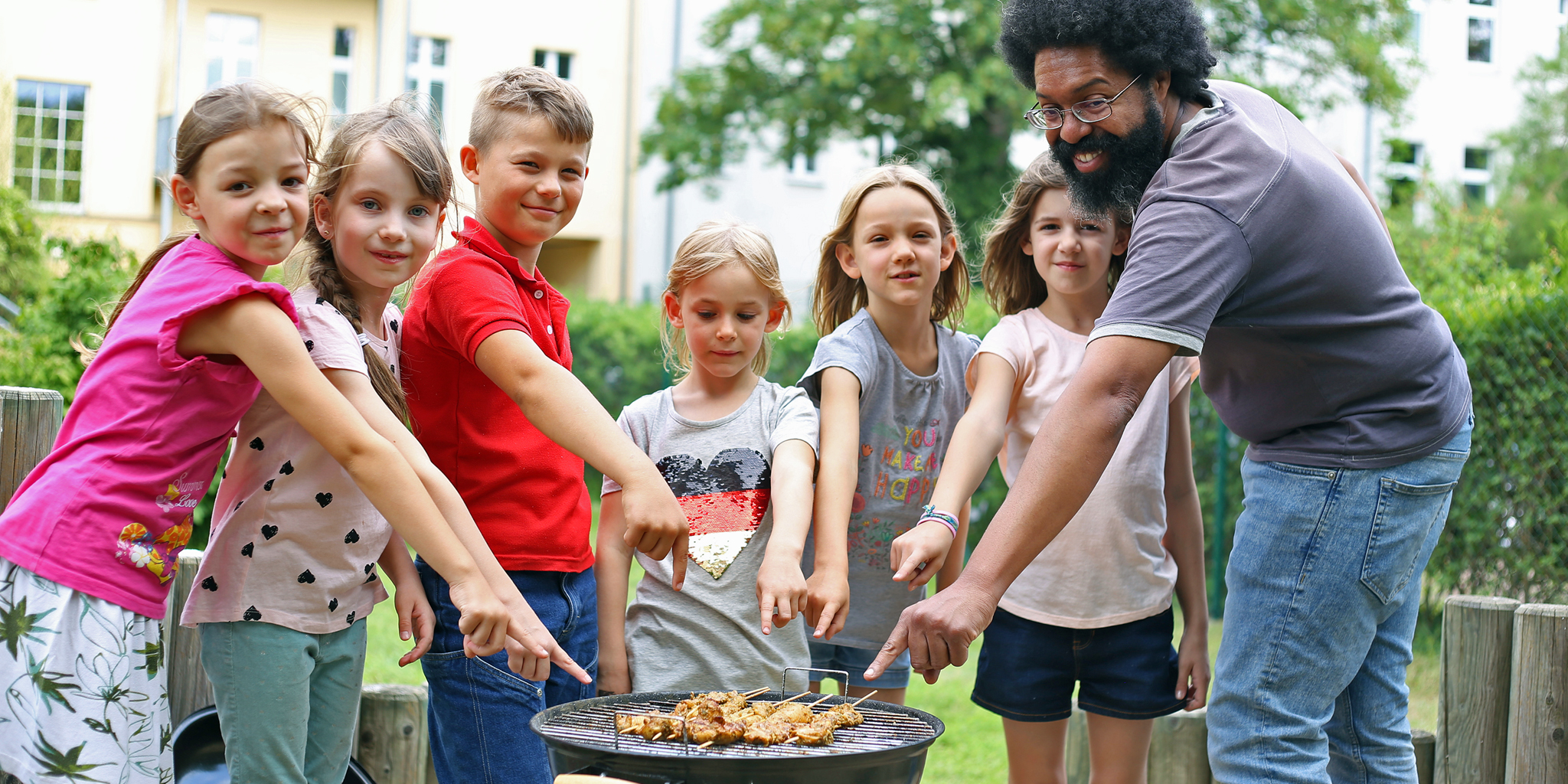
In Years 1 to 6, each school class has its own Class Erzieher. The children are accompanied through the day by their class Erzieher – during Support-Teaching in class, during Ganztag and study periods, during class council, on project days, at school events, during breaks and meals together in the canteen. They are important persons of trust and support the children in their learning and language acquisition as well as in their personal development. Together with the class teacher, the class Erzieher*in forms the class leadership team. Both colleagues work together as equals in order to support the children as best as possible in their academic learning and in their social development.
The Erzieher also plan and organise the afternoon program with over 30 clubs for all age groups and, together with our teachers and external club leaders, offer a wide range of working groups and clubs for the children. They also organise the exciting and varied holiday program for Years 1 to 6.
We offer our secondary students in Years 7 to 10 age-appropiate clubs according to their interests and with more demanding tasks, as well as consultations with the subject teachers, support with homework, more personal responsibility in the regular class council and in the school committees, and challenging projects.
Below you will find all the clubs we are offering this school year:
Arbeitsgemeinschaften

Art Club
EnglishAll children who love to be creative and are interested in art, design and artistic design, get to put their talents into practice in this club. We are inventive and productive outside of the usual art lessons. Our expressiveness, imagination and desire to be creative knows no bounds.

Badminton
englishAs one of the fastest ball sports, badminton is a rebound game and requires speed, concentration and tactical skill. The aim is to hit the ball over the net into the opponent's half of the field in such a way that the opponent cannot hit it back according to the rules.

Basketball
GermanBasketball comes from North America and is now popular in many countries around the world. This sport is characterized by its fast, focused and precise play. In our club, the children learn the basic techniques of basketball and train to play successfully in a team.

Board Games
ENGLISHWhat do all board games have in common? They are just really fun and encourage concentration and tactical thinking! Every week we play a different game, and the children are also welcome to bring their own games from home. It's never boring in this club!

Bookworms
GERMANBook worms are not just just sitting around reading! Each week when we open a book, we discuss the characters, what is happening in the story, and do everything we can to dive into a new world. We read and discuss together. Books can be chosen by students too.

Brainteasers
GERMANWhether Sudoku, crossword puzzles, or tricky conundrums - we ponder and fiddle, puzzle and guess, consider and think all over the place. Our brainteasers bring variety into the day, are fun, and promote concentration. Of course, we also think up puzzle stories ourselves.

Duke of Edinburgh Award
German/EnglishThis is a framework for non-formal education and experiential learning that motivates young people to challenge themselves outside the classroom in the areas of volunteering, sport, talent, and expeditions in a self-determined way and to develop as best they can on their own responsibility.

Film Club
EnglishIn this club, we learn about all the aspects of filmmaking: brainstorming, creative circles, writing stories, storyboarding, directing and filming. Children and young people who want to get experience in front of and behind the camera are all very welcome.

Fit Fighting
ENGLISHWith elements from Ju-Jutsu and other martial arts, our students learn to defend and protect themselves against attacks. In addition, we train our fitness, strength and flexibility in a holistic approach. No previous knowledge or physical requirements are necessary.

Football
GermanThe participants learn to play football and the rules of »fair play«. Presented in a playful context, they also get coordination training to optimally prepare their bodies for the game. But it’s the team spirit and all the fun of Europe’s most popular ball sport that comes first.

Handicrafts
German/EnglishWe deal with various materials and use them to make beautiful hand crafted items. There is sewing, knitting, crocheting, felting and embroidering – everybody gets to be creative and to contribute their own ideas. The created works can, of course, be taken home.

Debate Club
DEUTSCHIn this club, the participants train and sharpen their rhetorical skills and their ability to analyse and apply reasoning. We get together to debate current politically controversial and socially relevant topics and to take different positions on them.

Junior & Senior Choir
EnglishSinging makes you happy! The junior choir and the senior choir are performance choirs, in which we sing rock, pop and traditional songs. The children and young people are part of a professional ensemble and get onto the big stage at school events.

Ceramic Club
ENGLISHIn this creative club we explore and investigate the whole process and history of making ceramics and experiment coiling, pinching, slab building techniques. We create our own ceramic pieces, sculptures and functional objects that are fired and glazed at school.

Climbing
GERMANIt is a means of moving around that mankind has been using for longer than anyone can remember and it trains self-control, a sense of balance, courage, patience, self-discipline and caution. At "Berta Block" Climbing Hall, we learn the sequences of movements associated with climbing and benefit from mental and physical fitness.
Maths Challenge
ENGLISHTogether we solve puzzles that are very different from those in maths class. Practise lateral thinking, clever problem solving and ways of calculating that lead around corners. We look forward to seeing you in the Platanus Math Competition Team!

Model United Nations
ENGLISHModel UN are simulation games in which participants take on the role of delegates to the United Nations. In simulated bodies such as the Security Council or the General Assembly, the delegates debate global political issues, negotiate compromises, and pass resolutions.

Nature Club
GERMAN"Nature must be felt (...)!" We follow this quotation and the philosophy of the famous German explorer and natural scientist Alexander von Humboldt, dealing intensively with fauna & flora, the four elements, and discovering nature in the city in our surroundings.

Origami
GermanOrigami, the creative art of paper folding, is a millennia-old tradition from Japan. From a simple sheet of paper, we create two- or three-dimensional objects such as animals, flowers, paper airplanes, objects, and geometric bodies through artistic folding.

Oware & Afro Club
EnglishWho knows Oware or Ludo? We learn strategic board games that originate from Africa and we focus intensively on African culture. Our aim is to awaken interest in Africa and to develop multicultural understanding. Our goal is to have an exhibition about it in our school.

Platanus Post
GERMAN/ENGLISHThis group is suitable for students who like to write and pose clever questions. Our school newspaper thrives on exciting ideas for articles, puzzles, and interviews. With journalistic zeal and interests in a variety of issues, the participants learn to write exciting stories.

Robotics
EnglishThe goal is to participate in the German final of the World Robot Olympiad! With LEGO® BOOST we learn to build multifunctional models with motors and sensors using step-by-step building instructions and to bring them to life with simple, age-appropriate programming commands.

Rock Band
EnglishWe form our own bands and sing or play covers and our own songs. The focus is on writing songs and making music together as a group, but of course, we also offer individual support to both beginners and advanced users when it comes to playing all the instruments.

Rugby
ENGLISHRugby is a great team sport, originating in England, where you meet new friends and build bonds that last a lifetime. Open to all experience levels and genders - for anyone who wants to improve their communication skills and spatial-body coordination, increase their fitness, and have fun!

Science-Fiction Storytelling
EnglishOnce a week, we will craft stories with exciting sciences-fiction themes. From outer space to inner space, kids will learn about things like aliens, robots, and microbes through storytelling and crafts. No batteries included or needed, just imagination and fantasy!

Chess Club
EnglischChess has acquired a deep cultural significance, as the royal game is considered one of the most complex board games ever. By activating both hemispheres of the brain, playing the game trains the brain's performance and promotes logical-strategic and creative thinking to a high degree.

School Garden
GermanWe cultivate our numerous green spaces, plant insect-friendly flowers and bird-friendly berry bushes, provide splashes of colour in spring and summer, grow fruit and vegetables and increase the biodiversity on our school grounds.

School Radio
GERMAN/ENGLISHThe Platanus school radio created by the students for the students. We report, create, and discuss, in several languages, topics that interest us. To create our very own unique program, we record voices and sounds from the environment, and interview interesting people.

Swimming
GermanBeing able to swim safely, not only offers protection in and on the water, but also gives children a sense of security, independence and autonomy. The »Water Rats« association (Wasserratten e. V.) provides swimming lessons to beginners and advanced swimmers alike.

Knitting
ENGLISHKnit your own hat, a colourful scarf, arm warmers, or whatever your imagination comes up with. Knitting is incredibly contemplative and trains fine motor skills and hand-eye coordination. We look forward to a lovely chilled-out club to sit, chat, and KNIT!

Tastes from around the world
EnglishIn our international cooking course, we get acquainted with a new culinary highlight and cook seasonal dishes. The children learn to focus on their senses, to follow recipes and to realise just how connecting and important cooking and eating together is.

Theatre
GERMANWe offer a free space in which together we try out what language and movement mean to us. How do we use our body - consciously or unconsciously? There are many ways to express an idea, a thought, or an emotion. You decide the topics!

Volleyball
GERMANVolleyball is a very popular Olympic team sport. Two teams face each other on a court divided by a net and try to hit a ball over the net so that it touches the ground in the opponent's half of the court or the opposing team makes a mistake. It's just fun.

Wood Workshop
GermanThe children learn how to handle a variety of tools and they craft, build or process wood to produce useful and beautiful every day and decorative items. They learn the value of every discarded piece of wood that they can still use to conjure up something wonderful.
FAQ on our Co-Curricular Enrichment Program
Early care supervision takes place before lessons begin, from 6 to 8am, for all children in Years 1 to 6 whose parents already have to go to work. The children rest or play together and start the new day in a slow and relaxed manner.
Lessons start at 8.10 a.m. for all students in Years 1 to 6. For secondary school students in Years 7 to 13, the school day starts at 8.30 a.m. The respective class or subject teachers are present in the classrooms 10 minutes before the start and accompany the children/young people to a calm and organised start to the school day. Depending on the year level and the day of the week, the compulsory school day for each class ends between 13:30 and 15:30.
In order to make the school day as comfortable as possible for all students and have the daily routine run smoothly, the daily schedules for Years 1 & 2 vary from Years 3 & 4, Years 5 & 6 and 7 to 10 in lessons and break times as well as in Co-Curricular Enrichment times for Years 1 to 6. In this way, we ensure a quiet lunch time, relaxed break times in the schoolyard and optimal utilisation of the subject rooms. Each class receive their timetables and daily schedules at the beginning of the school year.
Our afternoon program takes places between 13:30/15:30 (depending on the day of the week) and 18:00, with lots of clubs in either the English or German language. These clubs are made up of school students from all classes, also for our students in secondary level.
For all primary school students in Years 1 to 6, afternoon supervision is provided until either 4 pm or 6 pm, according to the individual supervision vouchers. This consists of free play time in the schoolyard or in our spacious early/late care room on the ground floor.
Our school library is also open five afternoons per week and on two afternoons, the students have the opportunity to finish their homework in the homework hoom.
Lesson units or immersion activities can last for either 40 or 120 minutes. During this time, depending on age, development and the students‘ daily mood, one or more short breaks are taken, in which concentration is maintained by means of short movements or relaxation exercises.
Through this regular alternation of phases, which either demand increased attention or phases which practice relaxation, we accommodate the natural daily rhythm of the students.
In addition, individual, partner, group and station work, and other working methods change over the course of the school day.
This enables us to achieve optimal learning conditions for the children in all subjects and immersion activities throughout the day.
Ganztag functions as a bridge between lessons and playful learning: In addition to school subjects, study time, breaks and Klassenrat (class council), our students in Years 1-4 also have Ganztag integrated into their timetable. During this time, the class Erzieher*in is responsible for leading special activities. These are designed to strengthen team spirit and class cohesion, or to address interests and topics that are relevant in class or in everyday life. Together with their class teacher, the children deal with new situations in the class as well as with social or cultural issues. They deal with current circumstances, such as festivals or seasonal features, and address specific questions and current sensitivities in the class.
In Years 1 to 6, the students eat both lunch and snack at a table, as a class group, with their Class Erzieher*innen. It is important to us that all children have the chance to eat their lunch in peace. For this reason, we organise lunch breaks and snack times in different shifts, depending on the year level. Every child can take the time they need to eat and those who are finished eating are allowed to go and play in the schoolyard.
Lunch is prepared according to nutritional principles and delivered by the catering company Löwenzahn. Parents provide children with a healthy breakfast, an afternoon snack, and a water bottle with water or sugar-free tea. Students can fill up their water bottles at our water dispenser during the school day. Morning breakfast is served in the classroom before or after schoolyard break.
In cooperation with the Head of School – Year 1–10 (Ganztag) and our club coordinator, our colleagues design the voluntary in-school afternoon clubs according to their own strengths, interests, inclinations and the children’s ideas. We then develop and supplement these on an ongoing basis. Because of our linguistic immersion concept, the clubs are carried out in German or English, and sometimes jointly by two group leaders in both languages. The children get the opportunity to improve their language skills in a relaxed and natural atmosphere and in a smaller circle of people. After a trial period of around three weeks at the beginning of the year, the students attend the selected club for at least one school year. We determine in advance the ideal number of children for taking part in any one club. So, for example, we offer places in the Science Club to just a few participants, in order to create the best possible conditions for every child in terms of getting to performing experiments, while the Choir Club thrives on having a large number of pupils singing together. If a group has more applicants than places, then all students register and an anonymous selection is made to complete the club list. Each club focusses on its own key areas of competence. However, it is not only these, but also a variety of other skills that are developed and linked together.
If you have any questions about our clubs, please do not hesitate to get in touch via nt@cyngnahf-fpuhyr.qr. We would be happy to advise you in the selection of the most suitable group for your child.
We essentially follow the Berlin school calendar and have holidays at the same time as all other students in Berlin. All details and exceptions can be found in the document “Our holidays and closing times” in the download area.
We offer a varied holiday program from 6:00 to 18:00 each day during the school holidays. This program is for children in grades 1 to 6 and includes lots of interesting projects, exciting excursions and relaxed freeplay time.
In two weeks of the summer holidays we have a closing time with emergency care from 7.30 am to 5 pm, for which you have to register until April 30th. In the last week of the summer holidays, during Christmas holidays plus 3 days before the Christmas holidays and on bridge days our school is closed. In addition, the school is always closed 3 days after the winter holidays during our team days.
Of course, we share the holidays and closing periods with all parents in good time. You can find them in the download area of our website as well as on the internal Schulweb.
Applications for the holiday program or questions about it can always be directed to srevra@cyngnahf-fpuhyr.qr.
In the 1st and 2nd grade our students use open cloakrooms.
Every student from grade 3 onwards gets his or her own locker free of charge. Here the children can lock up school books, exercise books, sports bags, bicycle helmets and other personal belongings. For children in grades 1 and 2, a locker is optional.
The alternating phases of the rhythmic daily routine are also reflected in our room concept. Up until 4th grade, the students have two rooms with a connecting door available to them. The classroom is equipt with tables and chairs while the connecting Co-Curricular Enrichment Room is more individual with open spaces, relaxation corners, as well as craft and construction areas. These Co-Curricular Enrichment Rooms are also co-designed by the children. This concept allows the students to take a step back at certain times of the day and allows them to decide whether they want to work in the classroom or in the Co-Curricular Enrichment Room.
Year 5 to 10 have various group rooms available to them beside their classrooms. These rooms can be used for Team-Teaching, Support-Teaching or for working in small groups.
Please take a look around, if you would like to get an impression of our premises!
The class hour is called Klassenrat (class council), is a fixed part of the timetable and takes place once a week in all classes. The class teacher and (class) Erzieher*in use this time together to discuss topics that affect individual or all students and to monitor social processes within the class. The class council is at best moderated by the class representatives, if necessary with the support of the class leadership team, serves as an important basis for the concerns and worries of our students and is a democratic body to give all students and the class leadership team the chance to discuss possible problems but also to express praise and recognition.